


Search engine optimization has changed more in the last three years than it did in the previous decade and this time, the numbers back it up. As of mid-2026, AI Overviews now appear on roughly 40–50% of Google searches (estimates range from 43% to 60% depending on the tracking methodology), up from about 15–18% a year earlier. Google itself has confirmed AI Overviews now touch “roughly 50% of US queries.” That single stat is why this article exists.
For years, businesses focused on ranking websites by targeting keywords, building backlinks, and publishing optimized content. Those practices still matter but they’re no longer the whole game.
How Search Behavior Has Actually Changed
Instead of typing short keywords like “best laptop,” people increasingly ask complete questions:
- Which laptop is best for graphic designers under $1,500?
- How do I choose the right vacuum packaging machine?
- What is the difference between SEO and GEO?
This isn’t just a vibe shift it’s measurable. Pew Research Center found that AI summaries appear in 60% of searches that start with question words (“who,” “what,” “when,” “why”) and in over a third of searches phrased as full sentences. Long, conversational queries are exactly where AI-generated answers now dominate.
And increasingly, people get those answers directly from ChatGPT, Google AI Overviews, Microsoft Copilot, Gemini, Claude, and Perplexity instead of clicking through to a website. Google’s own AI Mode had reached roughly 75 million users by the end of 2025, and industry trackers estimate total search impressions have risen while organic click-throughs have fallen by 30–60% on queries where an AI Overview appears.
The important caveat: this isn’t uniform collapse. Early 2026 data from Seer Interactive shows organic click-through rates recovering somewhat after bottoming out in December 2025, and some practitioners report that the clicks that do survive an AI Overview convert better, because the visitor arrives pre-qualified. Zero-click doesn’t automatically mean zero-value but it does mean traffic alone is an incomplete scoreboard.
This shift has introduced two disciplines that now sit alongside traditional SEO:
- AEO (Answer Engine Optimization) – being the direct answer inside featured snippets, AI Overviews, and voice results
- GEO (Generative Engine Optimization) – being the source an AI model cites, paraphrases, or recommends when it generates a full response
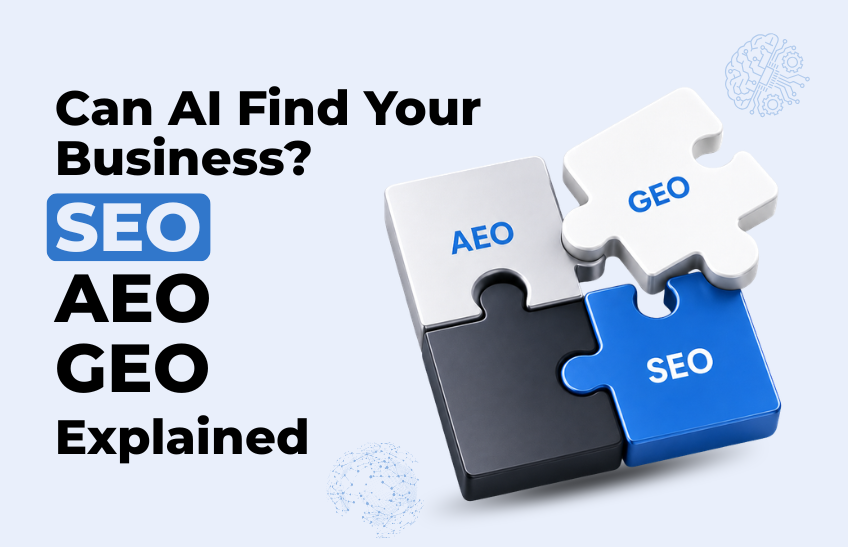
Together, SEO + AEO + GEO make up what’s now commonly called Modern SEO.
Traditional SEO gets you a click. Modern SEO gets you cited with or without one.
Why Traditional SEO Alone Is No Longer Enough
The old funnel:
Search → Click Website → Read Article
The new one, on an increasing share of queries:
Search → AI synthesizes an answer from several sources → User acts on it, often without clicking
This doesn’t retire SEO, AI systems still lean heavily on well-optimized, technically sound, authoritative websites to build their answers. It just means visibility now has two layers: ranking and being selected as a source.
Understanding Traditional SEO
SEO is the practice of improving a website so it ranks higher in search results and reads as trustworthy to both people and machines. It remains the foundation everything else is built on.
Keyword research has shifted from short head terms (“SEO”) toward full questions (“What is modern SEO and how is it different from AEO?”). Search intent now matters more than raw volume.
On-page SEO: titles, meta descriptions, heading hierarchy, internal links, alt text, URL structure — still helps both search engines and AI parsers understand what a page is actually about.
Technical SEO: page speed, mobile responsiveness, HTTPS, sitemaps, robots.txt, canonical tags, crawlability, Core Web Vitals — is arguably more important now, not less: an AI crawler that can’t parse your page can’t cite it either.
Off-page SEO: (backlinks, digital PR, industry citations, brand mentions) still functions as a trust signal, and increasingly as a citation signal too several 2026 citation studies find that Reddit, Wikipedia, and YouTube account for a disproportionate share of what AI Overviews cite, which tells you AI models weight community consensus and structured references heavily, not just domain authority.
Content quality: original research, expert commentary, fresh data, real examples separates pages that get cited from pages that get ignored. Thin, templated content increasingly gets filtered out entirely rather than just ranked lower.
What Is Answer Engine Optimization (AEO)?
AEO is the practice of structuring content so it can be lifted directly as the answer in Featured Snippets, AI Overviews, voice assistant replies, and knowledge panels.
AEO Best Practices
Answer immediately, then expand.
What is AEO? Answer Engine Optimization is the practice of structuring content so search engines and AI assistants can extract a direct, self-contained answer to a user’s question usually in the first two or three sentences.
Then go deeper below that.
Use real FAQ sections: built around the actual questions people type or speak not generic filler questions.
Structure with genuine heading hierarchy: (H2 → H3 → H4). This isn’t just readability; it’s how machine parsers segment a page into answerable chunks.
Use schema markup: FAQ, Article, Organization, Author, and Breadcrumb schema all help search engines and LLM crawlers understand page context mechanically, not just semantically.
Write like you’re explaining it to a person: not stuffing keywords. Every model in this space Google’s, OpenAI’s, Anthropic’s is explicitly tuned to prefer natural, well-organized language over keyword density.
What Is Generative Engine Optimization (GEO)?
GEO is the practice of getting AI models to cite, paraphrase, or recommend your content when they generate an answer regardless of whether the user ever visits your site.
Interestingly, citation behavior is not the same as ranking behavior. One 2026 citation analysis found that only about 17% of AI Overview citations now come from pages that also rank in Google’s organic top 10 down sharply from roughly 76% in mid-2024. That’s a real structural shift: ranking #1 and being the AI’s chosen source are increasingly separate battles with separate rules.
How AI Models Actually Select Sources
They generally weight:
- Demonstrated expertise and first-hand experience (E-E-A-T)
- Original data studies, surveys, benchmarks, proprietary numbers
- Clear organization that’s easy to extract cleanly
- Recency LLMs and their retrieval layers penalize stale content
- Corroboration across multiple independent sources, not just one confident page
GEO Best Practices
Publish something no one else has. A case study, an original survey, a benchmark you ran yourself. Models are far more likely to cite a number that only exists on your page than to paraphrase your restatement of someone else’s number.
Build topical authority through clusters, not isolated posts. A pillar page on “Modern SEO” supported by dedicated deep-dives on AEO, GEO, schema markup, and technical SEO signals depth that a single 2,000-word catch-all article can’t.
Add a real point of view. Comparisons, disagreements with conventional wisdom, “here’s what actually happened when we tried this”, this is what separates a citable source from a summarized one.
Update on a real cadence, not just for the sake of a “last updated” date. Refresh statistics, screenshots, and examples on a schedule (quarterly is realistic for competitive topics).
Strengthen brand and author signals, bylines with real credentials, an about page, consistent presence across the places AI models cross-reference (Reddit, review sites, industry publications).
Should You Add an llms.txt File?
This is genuinely new since the last time most “AI SEO” guides were written, and it’s worth being honest about it rather than hyping it.
What it is: llms.txt is a proposed plain-text (Markdown) file placed at your site’s root similar in spirit to robots.txt that gives AI systems a curated summary of your brand and links to your most important pages, so they don’t have to infer everything from raw HTML.
What it isn’t: an official web standard, a confirmed ranking factor, or a replacement for solid technical SEO. Google has stated publicly that it does not use llms.txt for AI Overviews or AI Mode its systems still crawl and rank your normal pages the usual way. No major AI crawler has formally committed to consuming it as a retrieval signal as of 2026.
The realistic take: it’s closer to good hygiene than a growth lever. If your CMS supports it easily (some, like Webflow, now do), publishing a short, curated llms.txt 10 to 20 entries, your most important pages, one to three sentences describing your brand costs little and can’t hurt. But it should sit behind the fundamentals in your priority list: crawlable pages, clean schema, genuine topical authority, and a technically sound site still move the needle far more.
SEO vs. AEO vs. GEO
| Feature | SEO | AEO | GEO |
|---|---|---|---|
| Primary goal | Rank in search | Provide the direct answer | Get cited by AI models |
| Audience | Search users | Voice & answer engines | AI assistants and their users |
| Focus | Rankings and traffic | Structured, extractable answers | Trust, originality, citability |
| Content style | Optimized long-form articles | Concise, direct-answer blocks | Authoritative, data-backed resources |
| Success metric | Organic traffic, rankings | Featured snippets, AIO appearances | AI citation rate, referral quality |
These aren’t competing strategies, they’re three layers of the same discipline, and most of the underlying work (technical health, clear writing, real expertise) serves all three at once.
E-E-A-T Still Sits at the Center of All of This
Google evaluates content through Experience, Expertise, Authoritativeness, and Trustworthiness and every AI system in this space leans on the same underlying signals, because they’re trained partly on the same web and partly on the same idea of what “reliable” looks like.
Practical ways to strengthen it:
- Real author bylines with actual credentials, not “Admin” or “Team”
- First-hand experience stated explicitly (“we tested,” “we measured,” “in our audit of X sites…”)
- Citations to primary sources, not just other blog posts covering the same topic
- Visible, current information outdated statistics are one of the fastest ways to lose AI citation trust
Measuring Success in Modern SEO
Traditional metrics still matter: organic traffic, rankings, click-through rate, conversions.
But they’re no longer the full picture. Add:
- AI citation tracking: tools like Ahrefs, Semrush, and newer AI-visibility-specific platforms now track how often and where your brand appears inside ChatGPT, Perplexity, and AI Overview answers
- Referral quality from AI platforms: measure conversion rate on AI-referred traffic separately, since it tends to behave differently than classic organic traffic
- Brand mention volume: off-site, since models increasingly weight how often a brand is discussed across the web independent of your own site
- Share of voice: on the specific questions your audience actually asks, not just your target keywords
The honest operator’s rule for 2026: track impressions, CTR with and without an AI Overview present, and downstream conversion separately don’t collapse them into one traffic number, because that number now means less on its own than it used to.
Common Mistakes to Avoid
- Publishing thin, AI-generated content with no original insight or verification
- Copying competitor structure instead of building genuine topical depth
- Ignoring schema and structured data
- Chasing llms.txt or other trendy tactics before fixing crawlability and content quality
- Letting statistics, screenshots, and examples go stale
- Weak or anonymous author credibility
- No original research or first-hand data anywhere on the site
Where This Is Heading
A few things look durable heading into the rest of 2026: AI Overview coverage is still expanding, not shrinking; citation sources are diverging further from organic rankings, meaning “rank #1” and “get cited” require increasingly overlapping but distinct work; and the sites doing best are the ones treating AI visibility as a measurement problem, not just a content problem they’re tracking citations the way they used to track rankings.
Final Thoughts
Modern SEO isn’t about chasing the #1 spot on Google anymore. It’s about building content that people trust, search engines can parse, and AI platforms are confident enough to cite by name.
That means combining solid technical fundamentals with genuine expertise, original data, and content built for extraction — not just for scrolling. The sites winning right now aren’t the ones gaming the newest acronym; they’re the ones that were already doing the fundamentals well and adapted the presentation, not the substance.
Frequently Asked Questions
Is SEO dead because of AI? No. It’s evolving, not disappearing. AI Overviews still lean heavily on well-optimized, crawlable, authoritative websites to build their answers you just now need to be citable, not just rankable.
What’s the biggest difference between SEO and GEO? SEO optimizes for ranking position. GEO optimizes for whether an AI model trusts your content enough to cite, paraphrase, or recommend it and, as 2026 citation data shows, those two things increasingly diverge.
Can small businesses realistically compete here? Yes, arguably more easily than in classic SEO AI citation studies show real weight given to original data and first-hand experience, both of which a small, genuinely expert site can produce more credibly than a large generic one.
Is schema markup important for AI? Yes it gives both search engines and AI crawlers a structured, unambiguous read on what your page is about, which matters more as more of the “reading” is done by machines rather than humans.
Do I need an llms.txt file? It’s optional and unproven as of 2026 Google has said it doesn’t use it for AI Overviews. Worth a low-effort add if your CMS supports it easily; not worth delaying real fundamentals for.
Should I write for humans or AI? Humans, always. Every AI system currently optimizing for “helpfulness” is, by design, trying to reward exactly the kind of clear, accurate, well-organized writing a human reader would also value.
How often should I update important content? Every 3–6 months for competitive topics refresh statistics, screenshots, and examples. Stale numbers are one of the fastest ways to lose both rankings and AI citations.